
THE MICROSOFT 365 BILL NOBODY READS
One enterprise tenant saved more than $350,000 in a year by reclaiming inactive licenses and removing overlapping SKUs.
— Orchestry customer result
Think about your own tenant for a moment. Nobody went looking for that money. It was sitting in a license report nobody had a reason to open.
From 1 December, new Microsoft 365 Copilot Business subscriptions switch on usage-based billing for agents by default. In From Uber to AI: Cheap Rides Don’t Last we argued the cheap ride is ending.
Before the meter starts, find the spend you already carry and have stopped noticing.
Where the Money Already Goes
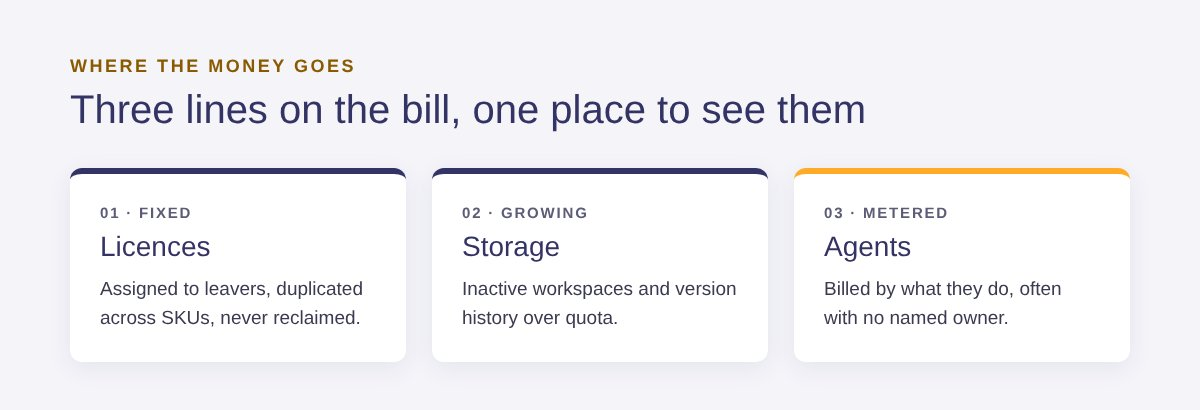
Most Microsoft 365 technical debt builds up slowly enough that by the time anyone notices, it’s already an expensive problem and a hard one to justify.
Licenses still assigned to people who left in March. Two SKUs covering the same user. Teams nobody has opened since the project closed, sitting in pooled storage you pay for once you pass quota. Version history quietly multiplying every file underneath them.
None of it appears as a line item. It appears as a renewal larger than last year’s, and a question from finance that IT can’t answer without a week of exports.
Orchestry shared one example; a client was confident they had no agents in their tenant. When they switched on agent discovery, they found a couple of hundred that nobody knew existed.
Technical debt is rarely a procurement problem. It is a visibility problem.
Agents Are the Next Line on the Bill
A license is a fixed number you can count. An agent is metered by what it does, and in most tenants nobody can yet say how many exist, who built them or what they read.
Employees are already building them in Copilot Studio, Agent Builder and SharePoint. Each one answers from whatever its user can reach, so an overshared site becomes an overshared answer.
In Not Every Problem Requires AI we set out when an agent earns its place: the input varies, the volume is high and a person checks the output. Under metered billing, that test is now a budget line.
What Orchestry Changes
Worth declaring our interest. Digital First is an Orchestry partner and implements it for clients, government among them. Which is why we would rather be precise about what it does.
Orchestry covers Teams, SharePoint, OneDrive and the agents built on top of them, in one place:
Licenses. Shows what is assigned, unassigned and inactive, with cost breakdowns. Flags overlapping SKUs and recommends what to reclaim.
Storage. Archives inactive workspaces once their owners confirm, and cleans up version history at scale. Archived content also drops out of Copilot’s reach.
Agents. One roster of every Copilot Studio, Agent Builder and SharePoint agent, each with a business owner and a risk score from 0 to 100.
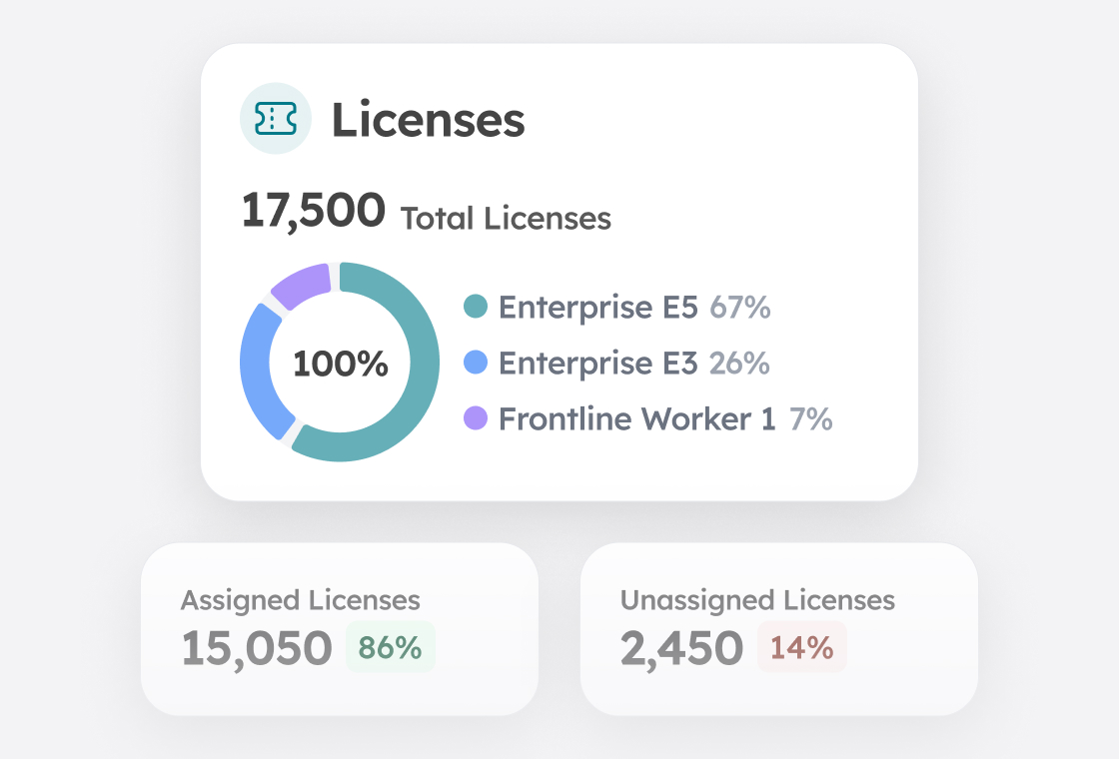
It runs on the Microsoft 365 E3 or E5 licenses most organisations already hold.
What changes is who does the work. The owner of each workspace, guest list and agent is asked on a schedule whether it should still exist. Cleanup no longer waits for IT to run a quarterly audit.
Where to Start
Start with what you already pay for, in this order:
Reconcile your license report against your leavers list.
Find workspaces with no activity in the past year, and ask their owners to confirm or archive.
List the agents already built in your tenant, and give each one a named owner before any are metered.
Each step is possible without Orchestry. Orchestry makes it repeatable.
The organisations that come through metered AI well will be the ones that can say what every license, workspace and agent is for, before the invoice asks.
See it on your own tenant. Contact us to book a 30-minute Orchestry demo and discuss implementation strategies.
Sources
From Uber to AI: Cheap Rides Don’t Last, Digital First, 30 October 2026
Not Every Problem Requires AI, Digital First, 4 September 2026
Orchestry Platform Guide 2026, Guest & User Management Feature Sheet 2026, and AI & Agents Feature Sheet (partner PDFs)