
FROM UBER TO AI - CHEAP RIDES DON’T LAST
Most of us remember the early days of Uber in Melbourne. A ride home from the city for roughly the price of a sandwich, a bottle of water in the back seat, and the quiet suspicion that someone was losing money on every trip. Someone was. Then came New Year’s Eve, the little lightning bolt on the screen, and a fare that made the walk home look surprisingly appealing.
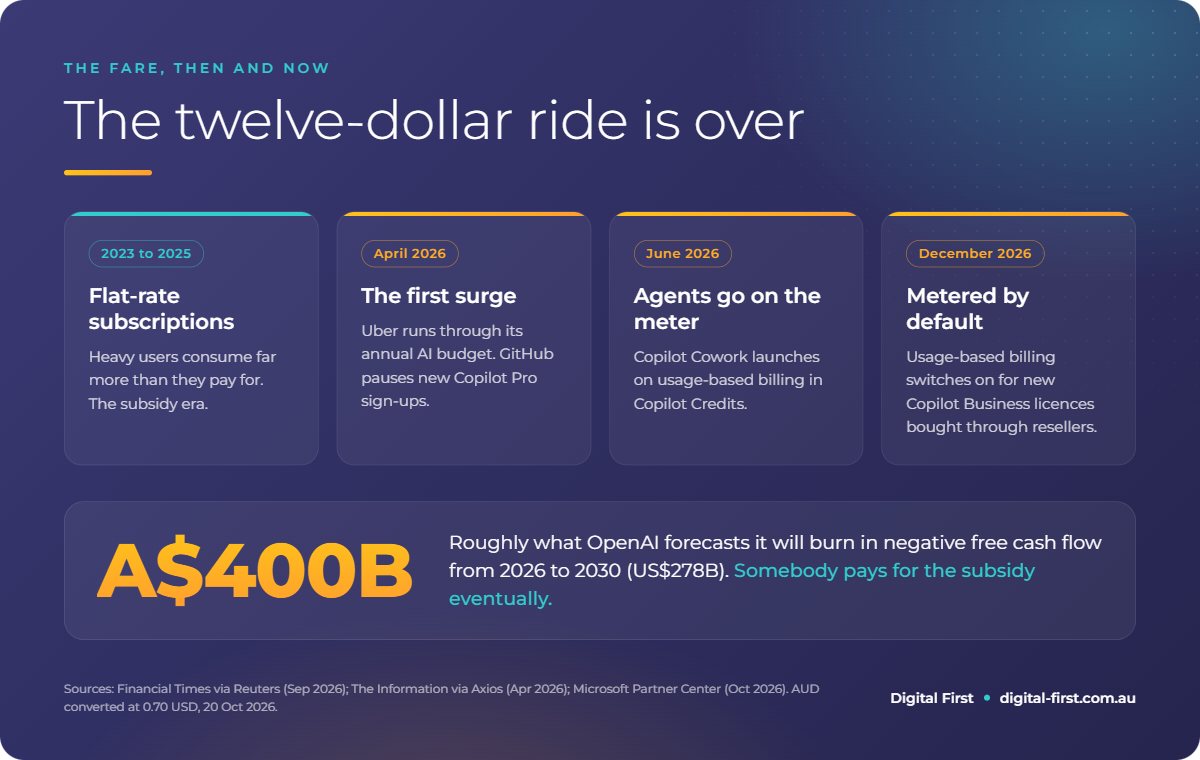
AI has spent three years giving everyone the twelve-dollar ride. The surge has arrived.
Uber’s chief technology officer exhausted the company’s entire 2026 AI budget by April.
— The Information, via Axios, April 2026
Uber, the business that taught the world about surge pricing, put its engineers on agentic coding tools at the end of 2025 and worked through the year’s budget in four months.
Someone Has to Pay for the Free Ride
Rideshare and AI companies share the same model, investors fund the losses while customers form the habit, and the price goes up once they depend on it. OpenAI’s own forecasts, reported by the Financial Times in September, show a negative free cash flow of US$278 billion, around A$400 billion, between 2026 and 2030. Losses on that scale can only be carried for so long, and the correction is already showing up in how AI is sold. Flat-rate subscriptions are giving way to metered billing, and agents consume far more data than any person typing prompts ever could.
Notable headlines this year have followed accordingly:
Uber exhausted its annual AI budget by April
GitHub froze new Copilot Pro sign-ups after agent costs overtook the price of the plans
Microsoft has reportedly withdrawn Claude Code from its internal engineering teams
Nvidia’s vice president of applied deep learning said compute for his team now costs more than the people on it
The Meter Comes to Microsoft 365
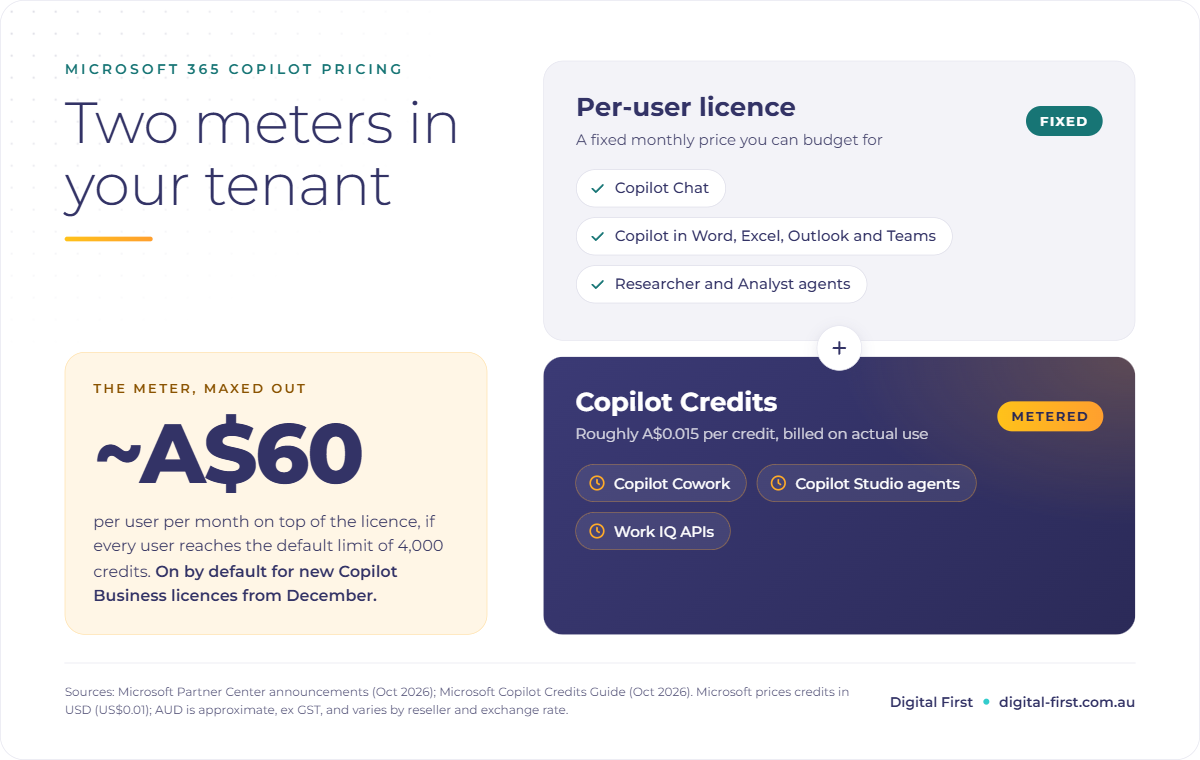
Microsoft 365 customers are not exempt. Microsoft has split Copilot pricing in two: everyday Copilot stays on the per-user licence, while the agentic work sits on a meter.
Covered by the licence: Copilot Chat, Copilot in the Office apps, and the built-in Researcher and Analyst agents
Metered in Copilot Credits, at roughly A$0.015 each: Copilot Cowork, Copilot Studio agents and the Work IQ APIs
On by default from 1 December: usage-based billing for new Microsoft 365 Copilot Business licences bought through a CSP partner, with a default spending limit of 4,000 credits per user per month
That default limit is up to around A$60 per user per month on top of the licence, before anyone has decided whether the work was worth it. To Microsoft’s credit, the spending policies and cost dashboards to control it are already in the admin centre, but unless someone sets them up, the meter keeps running.
Taking Control Before the Bill Arrives
Optimising now costs far less than unwinding a dependency later. Organisations that rebuild their processes around AI at subsidised prices are the ones most exposed when the price increases. Much like the restaurants that moved every order onto a single delivery app and then watched the commission climb.
Visibility: know which teams use which AI tools, for what, and at what cost. Salesforce research found more than half of Australian workers using AI rely on tools their employer hasn’t provided, so the real picture is wider than the official one.
Information foundations: AI retrieving from a poorly governed environment burns credits on the wrong documents and answers people have to ask twice. Good information management is now a cost control as well as a risk control.
Spending policies: set credit limits per user, group and agent before usage-based billing switches on, and review consumption against outcomes each month.
The right tool for the task: licensed Copilot for everyday work, metered agents only where the value clearly justifies the meter, and automation, search or a template where no model is needed at all.
Education that builds judgement: teach people when to use AI, when a simpler tool will do, and how to get a useful answer first time. Programmes that only measure how often people use it encourage exactly the consumption that blows budgets.
Room to move: avoid workflows so tied to one model they can’t shift.
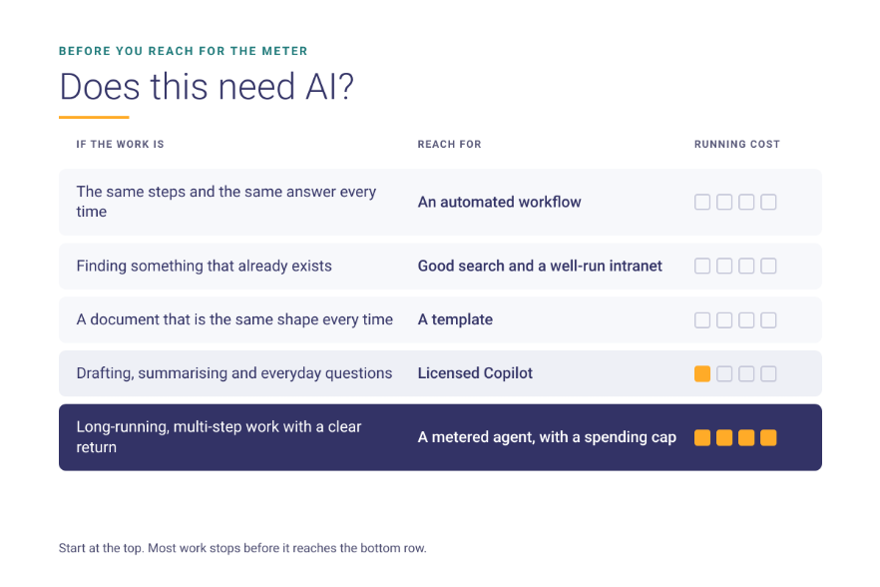
After fifteen years of integration and automation work, we’ve found that much of what businesses want from AI can be done without it. Where AI is the right tool, it delivers far more when it’s planned as part of a wider technology roadmap rather than bought on its own.
Is the Trip Worth Taking?
None of this argues for slowing down. The organisations that get lasting value from AI will be the ones that know where each dollar of consumption earns its return. When the surge reaches them, they can look at the fare and decide whether the trip is worth taking.
Everyone else will be standing on the footpath at half past midnight on New Year’s Day, wondering when the ride home got so expensive.